Snowflakes Stamp Brushes: A Practical Guide for Digital Designers
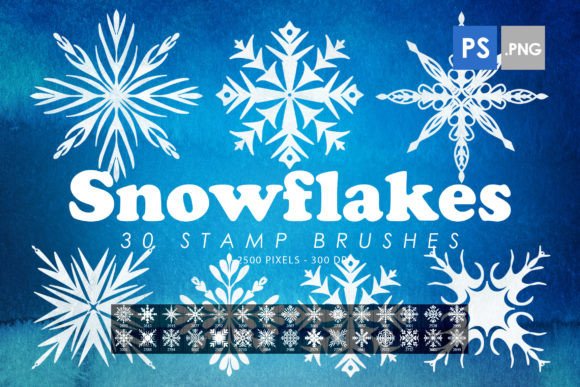
In the realm of digital illustration and graphic design, efficiency often dictates the quality of workflow. Designers frequently seek tools that balance aesthetic appeal with technical ease, particularly when working on seasonal or winter-themed projects. Snowflakes Stamp Brushes represent a specialized category of digital assets designed to streamline the creation of snowy atmospheres. This collection typically includes high-resolution stamp brushes compatible with Adobe Photoshop CS6 through CC, offering a versatile solution for adding intricate ice crystal details without the need for manual drawing.
Understanding the utility of these brushes requires looking beyond their visual appearance. They are functional tools intended to save time while maintaining professional standards. For designers evaluating whether to incorporate this specific asset pack into their library, it is essential to consider compatibility, resolution, and intended use cases. This article explores the practical applications, benefits, and limitations of snowflake stamp brushes to help you determine if they align with your current project requirements.
Understanding the Asset Structure and Compatibility
The core value proposition of this specific set lies in its technical specifications. The pack contains 30 distinct stamp brushes, each rendered at a substantial size of 2500 pixels. This high resolution is critical for modern design workflows, where assets must remain crisp across various media types, from web banners to large-format print posters. When a brush is defined as a "stamp," it functions differently than a standard scattering brush. Instead of painting a continuous trail, a stamp brush places a single, complete image of a snowflake with each click or stroke, allowing for precise placement and control over individual elements.
Compatibility is a primary concern for many users. These brushes are explicitly designed for Adobe Photoshop versions ranging from CS6 to the latest Creative Cloud releases. This broad support ensures that legacy users and those on subscription models can both utilize the tools effectively. Furthermore, the description notes that these brushes easily export into Procreate. This cross-platform flexibility is increasingly important for artists who switch between desktop and tablet environments. The ability to transfer high-quality assets from Photoshop to iPad-based workflows expands the utility of the purchase, making it a viable option for hybrid designers.
Practical Applications and Use Cases
The versatility of high-resolution snowflake stamps makes them suitable for a wide array of design contexts. Because they are provided as high-resolution images, they can function effectively as clipart or decorative elements independent of the brush engine. Here are several scenarios where these brushes serve as a strong fit:
- Holiday Marketing Materials: Creating eye-catching social media posts, email headers, or digital ads for winter sales requires quick turnaround times. Stamp brushes allow designers to populate backgrounds with snow rapidly, creating a festive mood without cluttering the foreground.
- Print Design: With a 2500-pixel base size, these images retain clarity when printed on greeting cards, invitations, or brochures. Unlike low-resolution web graphics, these assets can withstand the scrutiny of high-DPI printing processes.
- Web and UI Elements: For websites featuring seasonal themes, these brushes can generate subtle background textures or decorative dividers. Their transparency and clean edges ensure they integrate smoothly with existing color schemes.
- Digital Illustration: Artists working on concept art or children’s book illustrations can use these stamps to add atmospheric depth. By varying the opacity and size, illustrators can create a sense of distance and perspective in snowy landscapes.
The key advantage in these situations is consistency. Hand-drawing thirty unique snowflakes for every project is impractical. Using a pre-made set ensures a cohesive visual style throughout the design, maintaining professional uniformity.
Evaluating Benefits and Tradeoffs
When considering Snowflakes Stamp Brushes, it is important to weigh the advantages against potential limitations. No digital tool is universally perfect, and understanding these tradeoffs helps in making an informed decision.
Benefits:
- Time Efficiency: The most significant benefit is speed. Complex geometric patterns like snowflakes are time-consuming to vectorize or paint manually. Stamp brushes reduce this process to seconds.
- High Resolution: The 2500-pixel specification ensures that the brushes do not pixelate when scaled up moderately. This is crucial for professional print work where image degradation is unacceptable.
- Variety: With 30 different designs, users avoid the repetitive look that often plagues cheaper brush packs. This variety allows for more natural-looking snowfall compositions.
Tradeoffs and Considerations:
- Lack of Customization: As stamp brushes, the internal structure of each snowflake is fixed. Users cannot easily alter the geometric symmetry or add new branches to individual flakes without editing the source image in Photoshop. If a project requires highly specific, custom-engineered snow crystals, these pre-made stamps may be restrictive.
- File Size and Performance: High-resolution brushes consume more memory. On older hardware or when working with extremely large canvases, loading multiple high-res stamp brushes might slightly impact performance compared to lighter, vector-based alternatives.
- Style Specificity: The artistic style of the snowflakes is predetermined. If a designer is aiming for a hyper-realistic, photographic look or a highly stylized cartoon aesthetic that differs from the brush set’s design, additional manipulation will be required to match the project’s tone.
Decision-Making Insights: Is This the Right Tool?
Determining whether to invest in or utilize Snowflakes Stamp Brushes depends largely on your specific workflow and project goals. Consider the following questions to guide your decision:
Do you prioritize speed over granular control?
If your goal is to produce high-volume seasonal content quickly, these brushes are an excellent choice. They eliminate the bottleneck of creating complex shapes from scratch. However, if you are a purist who prefers building every element manually for total artistic control, you may find stamp brushes limiting.
What is your primary output medium?
For web-only projects, lower-resolution assets might suffice, but if you engage in print design, the 2500-pixel resolution is a significant asset. If you work exclusively in vector software like Illustrator, raster-based Photoshop brushes may require conversion or may not be the optimal format, although they can still be used as embedded images.
Do you work across multiple platforms?
If you transition between Photoshop on desktop and Procreate on iPad, the exportability of these brushes adds considerable value. It allows for a seamless workflow where you can start a composition on one device and refine it on another without losing asset quality.
Alternatives and Final Thoughts
While snowflake stamp brushes offer convenience, alternatives exist. Vector snowflake packs provide infinite scalability and easier color manipulation, making them better suited for logo design or large-scale signage. Procedural generation tools within 3D software can create realistic, physics-based snow simulations for motion graphics, though these require a steeper learning curve.
For static graphic design, digital painting, and general compositing, Snowflakes Stamp Brushes strike a balanced compromise between quality and usability. They are not a replacement for fundamental design skills, but rather a productivity enhancer. By integrating these high-resolution stamps into your toolkit, you can focus more on composition and layout, leaving the intricate details of ice crystal formation to the pre-designed assets. Ultimately, their value lies in their ability to deliver professional-grade decorative elements efficiently, making them a prudent addition for designers managing seasonal workloads.